Dialogic Reading: Apparently, looking at the pictures is reading too!

Well this article was about Dialogic Reading (which is an effective way to read aloud with young children).

Dialogic reading works.  Grover J. (Russ) Whitehurst said so.  Who wouldn’t believe a guy with a name like that?

               But really, the text claims that children can jump ahead by several months in just a few weeks of dialogic reading.  Color me intrigued.  With the header out of the way, let’s dive into the bulk of the text.  “Over a third of children in the U.S. enter school unprepared to learn.  They lack the vocabulary, sentence structure, and other basic skills that are required to do well in school.”  I’m not saying that I disagree, but I am curious as to whom these children are.  Who is entering school unprepared is it preschoolers? Kindergartners, 9th graders?  The text goes on to say that children who start behind generally stay behind, this leads me to believe that we’re talking about children on the younger side.  Which opens another question, how can preschoolers and kindergartners be so far behind?  They’re at the very beginning!  Sounds like the parents’ faults.  But I’m sure there’s more than one side to this.  But I digress…

                Huh…  The text blames the parents and siblings… lol.

                According to Whitehurst, “picture book reading provides children with many of the skills that are necessary for school readiness: vocabulary, sound structure, the meaning of print, the structure of stories and language, sustained attention, the pleasure of learning, and on and on.”  Without the hours of exposure to picture books that some young children are exposed to (usually via parents and older siblings), they are at a large disadvantage.  Simply put, children that are exposed to more reading at an early age become better readers.  The text states, “Children who are read to three times per week or more do much better in later development than children who are read to less than three times per week.”  Apparently, children can develop a fondness for books by as young as nine months!

                After all that fun, we finally get to the main idea.  What is dialogic reading?  Alas, it is a method of reading to preschoolers.  As opposed to traditional reading where the child listens as the older reader reads, in dialogic read, the adult helps the child become the storyteller.  It then becomes responsibility of the adult to questions and listen so that child can explain. 

This next part looks important, so I’ll just snag the whole thing…

“The fundamental reading technique in dialogic reading is the PEER sequence. This is a short interaction between a child and the adult. The adult:

  • Prompts the child to say something about the book,
  • Evaluates the child’s response,
  • Expands the child’s response by rephrasing and adding information to it, and
  • Repeats the prompt to make sure the child has learned from the expansion.”

This takes us to another funny acronym: CROWD.  It appears that CROWD is a list of prompts that adults use in dialogic reading to activate those peer sequences referenced earlier.  One of the first ones is Complete prompts.  Here you leave a blank at the end of a sentence and have the child fill in the blank.  The text says this is easiest with books that rhyme.  Another style is Recall prompts.  “These are questions about what happened in a book a child has already read.  Recall prompts work for nearly everything except alphabet books.”  Open-ended prompts focus on the pictures in books.  (Details help.)  Here you simply must ask a child what’s going on in the picture.  The text claims that open-ended prompts help youngsters increase their expressive fluency and attention to detail.  Wh- prompts usually use words like what, where, when, why, and how.  They can be used to teach new vocabulary and are generally basic questions like, “What’s happening?”  Or “Who is smiling?”  Then you have Distancing prompts.  Here, children are asked to relate the pictures or words in the story to real world experiences.  The example the article uses goes as follows, “Remember when we went to the animal park last week.  Which of these animals did we see there?”  These are all rather important skills now that I think about it.  As elementary teachers, we shouldn’t sleep on these prompts!

Note: this will be easier if the child is interested in the subject material.

The last section is clearly where the first sample of text came from.  This time they’ve added an extra sentence… (skip.)  Which brings us to the last paragraph.  Whitehurst has the honesty to claim that dialogic reading is just children and adults having a conversation about a book.  Children will likely enjoy dialogic reading as it’s a bit more socially inclusive and less rigid of a discipline.  Don’t force the children to bite off more than they can chew, and they should be just fine.  Apparently, they may even have fun.
A Speed Run of Effective Practices for Developing Reading Comprehension

                I’ve been reading Effective Practices for Developing Reading Comprehension. I want to say the authors were Duke and Pearson.  Regardless, it’s a lot to chunk.  But luckily, the text and diction isn’t as impersonal and weightless as it could be.  But after a while, it does feel like soulless text.  Complaining aside, we begin with a less than flowery opening discussing the “rich history” of reading comprehension.  He claims that over the past 40 years, reading education in general has continued to steadily improve.  The reader is then barraged by like 16 bullets points of what make a good reader.  The author states that teaching in what they allegedly call collections or packages of comprehension strategies can help students grasp text significantly better.

                One goal is to have balanced comprehension instruction.  My first question was what exactly does this mean.  What makes comprehension instructions balanced or unbalanced?  Balanced instruction requires that both explicit instruction in specific comprehension strategies and a lot of time spent reading, writing, and discussing what was read and written.  But this is no where near enough.  Beyond balanced instruction is supportive classroom context which includes: a great deal of time spent actually reading, experience reading real texts for real reasons, experience reading the range of text genres that we wish students to comprehend, an environment rich in vocabulary and concept development through reading, experience, and, above all, discussion of words and their meanings, substantial facility in the accurate and automatic decoding of words, lots of time spent writing texts for other to comprehend, and an environment rich in high-quality talk about text.

                Text then jumps into their idea of the model of comprehension instruction.  Their research has persuaded them into believe that the ideal model must include: an explicit description of the strategy and when and how it should be used, teacher and/or student modeling of the strategy in action, collaborative use of the strategy in action, guided practice using the strategy with gradual release of responsibility, and the independent use of the strategy.  The text claims that neither the teacher nor students should never lose sight of the need to coordinate comprehension strategies.  However, it seems that simply remembering what a good reader would do should keep a teacher on the straight and narrow when trying to instill good habits into young developing minds.  Other things that teachers need to consider include how appropriate the text is, student motivation, and assessments.

                The text then shares several pages of effective individual comprehension strategies.  I won’t go over all of them, but a list never hurts.  Remind your students to make predictions, occasionally think-aloud, consider the structure of a text (chronological, cause and effect, problem and solution, compare and contrast, and description), don’t be afraid to use visuals, ask the students questions, check to see if they have questions, and summarizing makes for good practice in discerning the important facts of text (write a topic sentence using the big idea, include main ideas in an order that makes sense, delete information that is redundant or trivial, reread for understanding and edit if necessary).  The text doesn’t say this exactly, but it does remind us to take into consideration how some students learn.  Some students are audio learners, some are visual learners, and so on.  It’s important to consider switching the way you teach or including modules that cater to those who have different methods of learning.  What methods work best for some students (and teachers) may not necessarily work best for others.

                Reciprocal teaching involves four of the comprehension strategies they’ve gone over (predicting, questioning, seeking clarification, and summarizing).  Quoting the text, “Originally developed by Annemarie Palincsar (1982; also Brown & Palincsar, 1985; Palincsar & Brown, 1984), reciprocal teaching involves a gradual release of responsibility from teacher to student for carrying out each part of the routine. In the early stages of the reciprocal teaching, the teacher does much modeling of the target comprehension strategies. In some versions of reciprocal teaching, this includes direct teaching of each individual strategy and the use of worksheets for practice strategies (e.g., Palincsar, Brown, & Martin, 1987). As time goes on, students assume increasing control over strategy use, eventually using the strategies with little or no teacher support.”

                Another important program is the SAIL program.  SAIL is an acronym for Students Achieving Independent Learning.  This system of learning works best when the teacher thinks aloud with students and explicit instructions.  For a better idea of what’s going on, the text provides a summary and… a summary/review of a summary, “Consider this summary of a SAIL lesson from a fourth-grade classroom:

• Teacher asks students to write a prediction about what the book will be about based on its cover.

• Teacher begins reading the book, thinking aloud as she reads (e.g.,“I wonder if that is the Georgetown in Washington, D.C.”; “August must be the name of a person”).

• Students take turns reading aloud. As students read, the teacher cues students to apply strategies as appropriate (e.g., “Tell us what has been going on here”).

• Students spontaneously employ strategies they have learned in previous work, including seeking clarification, relating the text to their lives, and visualizing (e.g., “I can see a…”).

• Students return to their written predictions to assess their accuracy.

As this summary suggests, there is not a predetermined sequence of strategies to use in SAIL lessons. Rather, strategy use depends on the situation; students must coordinate their repertoire of comprehension strategies. Also, more attention is given to individual interpretation of text than to “right answers.”

                There’s also a section on questioning the author.  While the information present in the text is cool.  I doubt that it’s necessarily practical for an elementary level class.  The text itself seems to agree as it later claims that this works best with a group of adult readers.  Perhaps younger (albeit capable) readers may lack the life experience or empathy required to use this approach.  I’m honestly not sure, but it neither sounds appropriate nor productive for the age group.  Although, it’s definitely worth revisiting for older students.

                Questions follow.  One of the main ones (that leads to pages of more questions is, “Where will comprehension research go?”  Honestly, I’m not sure.  I doubt people will just stop trying to find better ways to instill strong reading habits within others.  In addition, I’m not so sure that we’ve hit the wall just yet.  The text leaves us with a summary and then even more questions.  I don’t feel like answering all of them, but they did ask me one question that stood out.  Using far more articulate diction, they asked me if I felt that I witnessed what they had been speaking of in classrooms today.  In my opinion, most of the teachers I’ve seen in action do apply these strategies.  In nearly any class, you can see students and teachers interact socially in way described in this chapter.  I assume it’s the other way around, but I would almost surmise that have of the finding in texts like these are taken from regular classrooms and then studied after the fact.  But I’m sure that’s not how it goes.  Surely, the educators that I know are merely applying the knowledge they’ve learned from texts like these.  But how am I to know the truth?  I’ll simply have to settle for the mystery.

My Review of a Review reviewing Preschool Writing and Emergent Literacy Skills

                Now I have the honor of reading a 34-page document dubbed Examining the Effects of Preschool Writing Instruction on Emergent Literacy Skills: A Systematic Review of the Literature.  It seems that expectations for young children has increased over years.  If anything important was said after that, I missed it.  Anyway, in this study, they used Head Start’s definition of early writing as the familiarity with writing implements, conventions, and emerging skills to communicate attitudes and ideas through written representations, symbols, and letters (U.S.  Department of Health and Human Services, 2010).  Apparently, emergent literacy theory suggests children’s early writing involves experimenting with writing and a few other fun concepts about print.  Which I think is something I read about earlier.  The (Clay, 1991) is cited.  I believe that’s Marie Clay and we went over some of her work before.  The following quote can be found in the text linked by association above, regardless the text claims, “A growing body of research suggests emergent writing skills appear to develop at different rates, along a developmental continuum, and without a set sequence of activities (Levin et al., 2005; Puranik & Lonigan, 2011; Tolchinksy, 2003).”  In addition, some children are using early forms of writing to explore and record ideas at ages as young as two!  Additional, that chunk of information comes from (Rowe & Neizel, 2010) but if I were citing every bit of information found in this document, we’d be here all night.  But it’s likely safe to believe that children have a natural desire to write.  Graves said so.

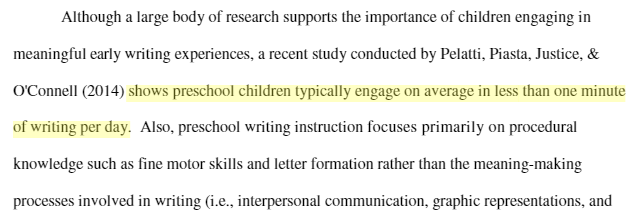
                Newsflash!!!  Highlighted text wows crowd with information you could probably guess!  Look below for more!

Who knew preschool children didn’t write?

                The texts also says, “Ultimately, preschool writing should aim to produce significant increases in children’s learning outcomes in the following areas: (1) attitudes toward writing, (2) engagement in writing, (3) oral language skills, (4) alphabet knowledge, (5) concepts about print, (6) phonological awareness, and (7) early writing skills (e.g., communicating and representing ideas through symbols and/or letters).”

                Later notes go over ideas such as environmentalist/behaviorist views, constructivist views, interactionist views, and maturationist approaches.  Honestly, I am not sure if know that helps or not.  I mean I’m sure it helps to be well informed.  But there’s just so much information.  I can help but feel that the more details that are included the less practical the material becomes.  However, that doesn’t mean that I don’t agree with the majority of what I’m reading.  I find constructivist theories like those of Dewey, Piaget, and Vygotsky rather sound.  Children likely learn in social scenarios much better than strict more traditional forms of early education.  There’s a lot to reflect on.

                Afterwards, we get pages of information from tables we can’t see.  It honestly feels like the type of stuff you would omit from a document like this.  You would just skip to the results and then cite a page with the actual process, right?  I don’t know, I hope I’m not coming off as lazy.

               At page 26, they legit say, “Thus, the findings obtained form this study need to be interpreted with caution.”  Out of context, this line is both hilarious and concerning.  Upon finally reaching what looks like some form of conclusion.  But on the off chance that you’re just as confused as I am, I’ll quote some text.  “Current preschool studies have investigated various interventions and instructional strategies in preschool writing ranging along a continuum of adult involvement, yet represented by three distinct philosophical approaches (i.e., maturationist, constructivist/interactionist, and environmentalist/behaviorist).”  They have some cool finding but have ultimately concluded that more research is necessary.  (Lol)  But it’s not like we’ll ever finish attempting to improve our teaching methods.

Tips from Alison’s Workshop

                So, this nice young lady named Alison, literacy specialist and consultant, has put together a nice little writing workshop for teachers looking to make their young students better readers.  Here, she claims that she’ll tell us how to plan a writing workshop, what should be taught at the beginning of the school year, how to get children to go from drawing to writing, and how we as teacher can help our students stay on task.

                It looks like the first thing you must do is plan out your procedures and expectations.  You know what they say, those who fail to plan, plan to fail.  Alison says we need to ask ourselves, “What do we want writing workshop to look like eventually?”  This should help us conceive a mental picture of the reality we wish to create.  First things first, what materials do you need?  Pencils, paper, tape, markers, folders, etc.  Having an idea of what you need taken care ahead of time can save you time during the actual workshop.  It’s a good thing to keep in mind.  Alison also mentioned something about it may be useful having materials that your students can access independently.  May save you even more time.

                Time is always a factor when you work in classrooms.  She gives us a time frame she works with, but this is likely a case by case basis.  But she does state that if you plan on have writing workshops that are somewhat lengthy.  Start off slow.  Maybe have short 5-minute stations that gradually grow over the year.  Consider a clean-up signal or some sort of marker saying when time is nearly up.

                After that she goes more in depth regarding the routine expectations, where and how students should sit, and will students have dedicated talking and writing partners.  Honestly, they’re all things that are worth considering.  Concepts like these you’ll likely come across just planning you average morning meeting.

                Alison says that early lessons don’t require too much planning.  Teach one skill at a time!  If anything, a large lesson may be too overwhelming or time consuming.  She suggests utilizing minilessons instead.  She claims this works best for younger students who may not be adept at following directions or even holding a pencil for that matter.  She claims that beginning lessons can range from using crayons and pencils, to storing folders and getting paper.

                She’s having a lot of fun plugging her other lesson ideas, articles, and other things.

                “… meet them where they are.”  That’s a famous line for teachers.

                A little later, she goes over some drawing tips for kids.  Then she dropped a few bombs of teaching wisdom, “While we spend time working on drawing, I’m simultaneously teaching the letter sounds (at another time of the day). I’m also using an alphabet chart, so that my kids can eventually use it as a tool during writing time.

Then, about 2 weeks into the school year, I begin modeling how to label things in my pictures. I think aloud as I do so, showing students how to stretch out words to listen for their sounds. I also model how to use an alphabet chart to find the correct letters.

After multiple days of modeling, I ask kids to try it out. I often encourage them to draw some type of picture with their family members in it, and then label their family members with words like “mom,” “dad,” etc.”  Believe it or not, those were only a few of the wise tips she had to share!

                She then stresses the importance of keeping an eye on your students.  You never know when they’ll stop paying attention or when they may miss the message.  For both behavioral and content learning reasons it’s a good idea to make sure that they’re keeping up.  While you cannot expect all students to be as altruistic and or honorable (as applicable), but some students will find good work to be their own reward.  When in doubt though, some positive reinforcement probably would hurt.  Alison then concludes her workshop on workshops by plugging more of her workshops…  Hilarious.

Reading Beyond Content

hReading documents like these is always difficult for me.  Long amounts of small, informational text with little to no personality isn’t much fun.  Some days I cannot believe that I was an English major.  So much reading!  But now, let’s get to the reading.

It appears that this text is about interactive book reading and language development in preschool classrooms.  It’s a lot to take in…  But I’ll do my best to take notes.  First and foremost, reading is good.  Everyone seems to agree on that.  Youngsters being read to is also good.  (We’re on a role!)  But, did you know that “Children whose parents engage in conversations that go beyond the explicit information presented in the story performed better on vocabulary measures as compared with children whose parents focused primarily on the explicit message of the story? (DeTemple & Snow, 1992)”  The text goes on to say that children who engage in higher level conversations and talk about the story did better on vocabulary and language stuff than kids who only looked at the pages and described what they saw or answered basic questions (Haden, Reese, & Fivush, 1996).  Poorer communities may not be as lucky.  Astoundingly, a Carnegie Foundation report claimed that 35% of the children entering school lacked necessary skills in the areas of vocabulary and sentence structure.  Most of these students were from lower-income homes.  The takeaway lesson here is that reading is at the heart of the research.

Dialogic reading is known to improve reading slightly better than the standard method of reading with children.  Dialogic reading includes a series of procedures in which the adult asks open-ended questions, creating opportunities for children to participate in storytelling.  They continue to actively listen and encourage a discussion about the story.  I think…  I may have read that incorrectly.

An important bottom line of text comes from this paragraph, “Children whose teachers provided multiple opportunities to interact with vocabulary words learned more book-related vocabulary compared with children who were exposed to just the books. Through the interactive book reading, the teachers introduced vocabulary words in a meaningful context. Also, children were given the opportunities to talk and ask questions about the story and to listen to other children’s conversations about the stories. The story props helped the vocabulary words come alive for the children and provided additional opportunities to hear the label for the words. In addition, as the props were very interesting and inviting to the children, it was likely that motivation to learn the names for the props was enhanced.”  A later paragraph concludes, “As Hart and Risley (1995) found, teaching young children language and vocabulary in the early years helps them develop skills that they can continue to build on. Providing an effective intervention for preschoolers hopefully can foster important vocabulary skills and motivate children to expand their language and learn new words.”

Long story short, reading books and talking about more than what’s on the page will do wonders for a young reader. It’s just unfortunate that lower-income families don’t seem to be putting as much emphasis on the practice. In addition, some students only go as far as their instructors assume they can go. It’s important that any teacher who dares call him or herself so, never give up on their students or allow them to give up on themselves.

Running Records… More like Ambling Accounts.

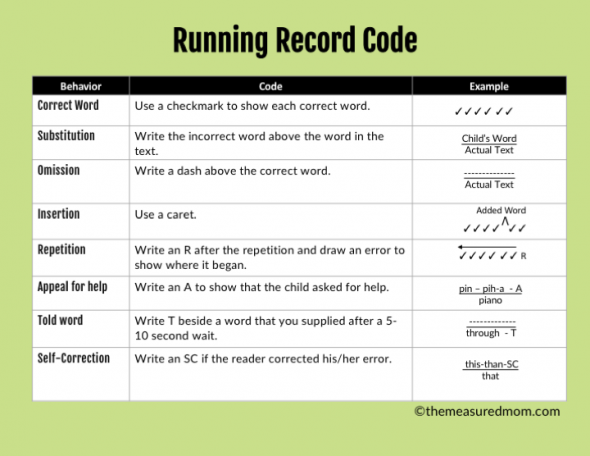
Running Records is a system of tracking and analyzing a student’s reading ability in general and potentially recording their improvements over a time.  That seems pretty nifty if I do say so myself!  After giving it a try, I must say it isn’t all that challenging.  Initially it looks intimidating (what with those equations and whatnot), but honestly, it’s nothing but plugging in information.  Remember, just because you’re making a mark besides a check doesn’t necessarily mean you’re marking errors.  Not every mark is an error.  My only concern is that I would not be able to do this swiftly enough.  I would probably need to record my students’ respective audio first and write down the results later.  I’m a slow writer in that respect admittedly.  Not to mention, there are a few conventions that most rubrics/cheat sheets don’t cover.  But the odds and ins itself doesn’t seem too demanding.  But this is only half of the show.  Let’s see if I’ll be whistling the same tune after I finish the module.

These are only a few of the codes you will come across studying Running Records.

Above is a neat example of a Running Records sheet. Apparently, they come in various shapes and sizes.

Regarding the calculated percentage I would just look to this information here:


                I already said what we can do with running records, but it looks like the video gives a better explanation than I ever could.  Apparently, scoring running records correctly can help when:

  • Choosing appropriate leveled texts for a guided read group (mostly instructional level);
  • Helping to decide when a group is ready to move to a higher level of text;
  • Grouping and regrouping students in guided reading groups;
  • Providing guidance for choosing appropriate leveled texts for individual students for independent reading (mostly independent level);
  • Self-evaluating our teaching in terms of the progress students are making in moving up text levels.

Hey, it seems we have some text to investigate as well.  So, it seems as though Running Records was design by Marie Clay.  The text claims, “A Running Record is not just the recording of right and wrong words.  It requires observing all behaviours to help determine the “thinking process” children are using as they read the text.”

Cue Cues

                What the heck is a meaning cue?

                “Meaning cues relate to a reader’s ability to gather a book’s basic message by making meaning of it at the text, content, and word level.”

                What the heck does that mean?

                I’m not 100% on this, but I think it’s some sort of deep level context clue but possibly error based.  I’m not sure, but apparently you should be asking:

                Does the child’s attempt make sense considering the story background, information from pictures, and meaning in the sentence?  If so, circle the letter “M.”  At least that’s what the text says.  Who am I to argue with the almighty text?  Marie Clay be praised!

                Apparently, there are other cues as well.  Structural Cue users are cool characters that rely on their knowledge of the grammar and structure of the English language to make the text sound right.  These readers investigate whether the word or sentence sounds correct.  For each error, you should be asking, “Does the child’s attempt sound right considering the structure and syntax of the English Language?”  If yeah than an S gets circled and this is starting to sound silly.

                There are also visual cues.  These cues include the way letters and words appear.  Loosely paraphrasing (mostly quoting) the text, a reader using visual cues will see the features of words and letters and then connect these features to their knowledge of the way words and letters sound when they are spoken.  Once again, it is important that we understand how to read the errors of reader reading this way.  According to the text, you should ask yourself: Does the child’s attempt visually resemble in any way the word in the text (e.g., begins and/or ends in the same letter)?  Well ladies and gentlemen, if you answered yes than this young man or woman has used their, (Drumroll, please.) VISUAL CUES!  You may now circle the letter “V” in the error column assuming the sheet your using provides one.

                Jokes aside, this does seem like a useful way of keeping track of student growth in reading.  I should definitely consider utilizing this tool as a teaching professional.

               Hmm… Just noticed if I had kept reading the text, I wouldn’t of had to find to Running Records example sheets I found.  I could have just used what was in the pdf (PDF found in link at beginning)…  Dagnabbit!

How would I go about teaching writing?

I’m no pro teacher or anything. So excuse me if this ideology is perfect but imagine that teaching writing isn’t too difficult. Some students will understand certain concepts before others, but that’s every subject. So… here comes the part where I copy from my word document.

Write a mini lesson!

  • Teach kids how to write.
  • It should be 10 – 15 minutes.
  • Use ideas like identifying the goal, explicitly defining key terms, guided practice, independent practice, shared writing, write aloud, interactive writing).

Example Persuasive nonsense

                My plan for teaching writing would at first have a strong emphasis on working together.  Once the ball was rolling, I would then consider having the students work on their own.  Regardless, I would start by telling them about introductions.

Example:

               INTRODUCTORY PARAGRAPHS SHOULD HIT THE GROUND RUNNING!  We want conviction*!

I would also probably describe what I meant by conviction so that none of my students would be confused.

*The bringing any one to recognize the truth of what he has not before accepted; convincing.

*The mental state or condition of being convinced; strong belief on the ground of satisfactory reasons or evidence; settled persuasion.

An ideal introduction starts off with a bang!  I would strongly suggest that students consider terms that sound powerful.  Say, “I believe,” instead of, “I think…”  Sounding sure of yourself and confident in your findings is key to any persuasive argument.

From here we will introduce our three main body paragraphs (example: I believe that __________ because this, that, and the other.).  Use this to introduce the Essay Organizer. (Intro, 1st body with 3-4 points, 2nd body with 3-4 points, 3rd body with 3-4 points, conclusion).  Maybe draw it?  Definitely draw it!  Identify what three points, arguments, or opinions you wish to address.  State them for now, but don’t forget them.  They will become important later.  Finally, I’d acknowledge the other side of the argument.  Perhaps pacify them with empathy, but then respectfully disagree and proceed on with proving your claim.

                Okay so… Remember that body paragraph stuff? We’re going to Incorporate that now.  Take a few minutes to fill out the table with some ideas (and hopefully a few facts) that can back up each section.

                If completed correctly, this becomes a bit of a plug and play scenario.  Go over how.

                Jump to the conclusion.  First, paraphrase the coolest most powerful sentence in your introduction (assuming we didn’t go over what a thesis is).  Restate a few of your reasons why (multiple sentences would help).  Throw a bow on it or add some catchy end line.

                I suppose a scrappy example would go like this:

Assuming I didn’t draw my own, I’d likely use the Graphic Organizer below or something similar in the process (Note: I did not create this graphic organizer, I’m just displaying it because it’s similar to something I have once used.)

Talk about intros.  Work together.  Tell student to pick favorite cereal or worst cereal.  Then together help them write their respective introductions.  The goal being to convince the audience that said cereal is either the best or worst in history (I could probably come up with something better than that topic, but this should suit the assignment at least.)

                Intro:

                I believe that XXXXXX brand Glazed Wheat is the best (or worst if you choose that route) brand of cereal in the world.  Glazed Wheat is the greatest because they do 1st, 2nd, and 3rd.  I understand that XXXXXX’s Choco Croc-O’s have potential and support a balanced breakfast.  However, I can prove beyond reason of a doubt that the undisputed superior cereal is none other than the Glazed Wheat.

I would probably always go over the 1st body paragraph together as well.  Just so they understand how to take whatever they had written on the template chart and apply it to their essays.

                1st body paragraph:

                Previously, I had mention that 1st promotes _______.  Studies completed by so & so have shown that 1st’s amount of ______ can affect the body in X ways.  (Lists a few ways).  Glazed Wheat also contains X’s which is also good for the skin and energizes you for a long day’s work!

               Do the same for the other two paragraphs.  However, I would trust them to use and practice this on their own. Having them practice on their own is important too.  My only worry is that something like this normally becomes homework, right?

                Conclusion:

(restate)  In conclusion, Glazed Wheat is the best cereal in stores today.  The cereal can easily 1st, its 2nd’s are beyond need of assistance, and 3rd is an important ingredient for any distinguished consumer.  The only question that remains is, “Why are you still reading this when you should be purchasing a box of XXXXXX brand Glazed Wheat?

               That was a sloppy and brisk example of the lesson, but that procedure accomplished serious strategies can yield positive results.  Talking about transitional/temporal words and other tools for writing would’ve help.  But in the end, writing cannot be mastered in a day, it’s debatable whether mastering writing is even possible.  What we do know is that It takes years of practice and correction to obtain even passable writing skills!  Not to mention, persuasive writing is only one genre of writing.  Had I have been talking about narrative writing, I would require a different template (see below) and an entirely different plan of attack (for lack of a better term).

(Again, I Robert Moore do not claim to own these images.)

Revisiting Phonics

So…  Phonics, am I right!?

                How do we introduce?  What are they?  Could they give me courage?  So many questions!  Let’s find some answer!

                This selection starts off by admitting simple things like orders for which to teach sounds like the sounds coming from the letters: a, m, t, s, i, f, and d.  It’s about starting of simple and sounds like those may be the way to go.  The text says to teach students to recognize and write letter combinations (such as grapheme/phoneme correspondences).  Naturally, you should begin with combinations that aren’t too difficult like consonant digraphs: sh, ch, th, and ck.  Looks for how those phonemes can be applied (the text gives an example of “sh” being used in the words ship, mission, and chef.  Get a jump on vowel digraphs such as: or, ue, ie, and ee.  Then similarly to the consonant digraphs, see how they can be used.  The example being “or” as it’s used in torn, door, and warn.  The words haul, law, and call were written there as well, but honestly, I’m confused as to why they’re in the same area as the first three examples.  Regardless, just make sure you also go over the rules between a long vowel or a short vowel.  Sometimes, a second vowel later in a word can make the original vowel say its own name.  The text was kind enough to give us examples here as well.  This come into play in words like gate, shine, tune, and bone.  I think I used the word make earlier… that’s also a good example.

                The text also reminds us to go over things like this, “Use known letter combinations to blend and segment words, that is, CVCC e.g. desk, park and CCVC, e.g. slip, drag. Segment words into onset (the part of the word before the vowel) and rime (the part of the word that includes the vowel and onwards), as in slip: sl (onset) and ip (rime).”  I always for onset and rime.  Those are simple notions, yet I hardly remember them.

                The pages (18 and 19) that follow contain an extensive list of Vowel and consonant phonemes as well as some of their graphemic (letter) representations.  Honestly, any good elementary educator would constantly revisit them to help keep younger students on the straight and narrow!

                Let’s see…  Oh, apparently the NSW English K-6 Syllabus of 1998 has this to say,

                “Knowledge of letter-sound relationships gives students a degree of independence in learning to recognize words and in reviewing them.  It develops students’ visual images of words because it allows them to attend to the letter components of the words and their sequencing.  It is important that students understand that the pattern of letters that is unique to each word is not arbitrarily chosen but depends on a conventional system.  The English language uses the alphabet to relate printed letters to speech sounds using a system of correspondences (the alphabetic principle).”

                I hate just copying and plugging in, but we have some information on the four literacy resources that may come in handy later.  Learning this is critical to developing literacy.

                Code-breaking – the ability to break the code of written texts by recognizing and using the fundamental architecture of written language, including the alphabet, sounds in words, spelling, structural conventions and patters.

                Meaning-making – the ability to understand and compose meaningful written, visual, spoken, digital and multimodal texts.

                Text-using – the ability to use written, spoken, visual, digital and multimodal texts in functional ways within and outside the school setting.

                Text-analyzing – the ability to critically analyze written, spoken, visual, digital and multimodal texts and understand that texts represent particular points of view and influence people’s ideas.

                “The teaching of phonics can be said to be explicit, systematic, balanced and integrated when teachers:

•Know the phonics knowledge, understandings and skills required by the NSW English K–6 syllabus and A suggested sequence for introducing new phonics learning (p. 17).

•Use assessment information to identify phonics learning goals for all students.

•Take into account the diversity of learners in classes and make appropriate adjustments to their planning, teaching and assessment.

•Group students based on phonics assessment information, understanding that student grouping needs to be flexible and will change as students’ needs change.

•Based on an effective phonics learning sequence (p. 17), plan focused mini-lessons on phonics.

•Explicitly teach phonics skills through modelled, guided and independent teaching strategies (p. 24).

•Integrate explicit phonics teaching with teaching phonemic awareness.

•Include opportunities for students to practice and apply phonics knowledge and skills within the literacy session and other learning areas.

•Teach phonics in a stimulating and rich literacy environment, that includes the use of authentic texts and contexts.

•Ensure that over time, students receive balanced instruction in the skills and knowledge needed to be effective code breakers, meaning makers, text users and text analysts.”

                Again, I hate just copying and pasting in these situations, it hardly feels like note taking but instead setting yourself up for fact or concept memorization.  But I suppose that isn’t the worst thing…  On a side note, there are quite a few spelling mistakes in here from time to time.  We’re all guilty of this, but you assume that they would have had somebody proofread this stuff, right?  Perhaps is just a regional spell/dialect thing…  Because I mean they’re doing things like spelling practise instead of practice and analyse instead of analyze.  It just small things like that.  Regardless, here’s even more shamefully copied information.

                A process for explicit and systematic phonics teaching

  1. Assessment for/of learning

Assess students’ phonics learning to determine their current level of knowledge and skills and provide them with purposeful feedback about what they can do.

  • Planning

Plan a lesson or series of lessons based on assessment and clearly focus planning on what needs to be taught and how it is taught.

  • Instruction

Use modelled, guided and independent teaching to explicitly support students to achieve phonics lesson goals and engage students in summative reflection on their learning.

  • Repeat

Do it again…

Earlier, you might have heard the text mention modelled, guided, and independent teaching.  Well let’s go over that real quick.

Modelled teaching:

The teacher uses this teaching strategy when students need to learn new phonics skills and concepts.

The teacher assumes major responsibility for directing and controlling the literacy interactions that take place between the teacher and students.

You might hear teachers say: This is the letter ‘a’ and it makes the sound /a/. This is the letter ‘m’ and it makes the sound /m/. I can push them together like this /a/–/m/ to make the word ‘am’.

Students are likely to be saying/thinking: I have learned a new phonics skill.

Guided teaching:

The teacher uses this teaching strategy when students need guided support to practice and apply new phonics skills and concepts.

The teacher structures literacy interactions in a way that allows students to assume more responsibility and demonstrate more control over what they are learning.

You might hear teachers say: Listen to the sounds in the word ‘dad’ and find the three letter tiles to make the word. Well done, you found the ‘d’ for the beginning and end of ‘dad’. Listen for the sound in the middle of the word and see if you can find the letter for that sound.

Students are likely to be saying/thinking: I will have a go at using this new phonics skill by myself, but I know I will still need some help.

Independent teaching:

The teacher uses this teaching strategy when students need minimal support to apply and demonstrate new phonics skills.

The teacher structures literacy interactions in a way that allows students to assume a greater degree of the responsibility for literacy learning.

You might hear teachers say: As you are reading today remember to practice blending the sounds together when you try to read new words.

Students are likely to be saying/thinking: I know how to use this phonics skill and when and where I need to use it.

                Okay, so whose idea was it to write students are like to be saying/thinking?  That sounds silly.  Why not just, “Students are likely saying/thinking,” or even simpler, “Students are likely thinking…”?  Adding “to be” sounds improper.  Additionally, I assume just using thinking would be more appropriate than saying/thinking because I’m pretty sure the average student wouldn’t scream to the desk next to theirs that they have learned a new phonics skill.

                On that note, that’s enough notes from here.  The concepts are good, but the text is long, and I’ve been studying for a while now.  See ya!

Much ado about Phonemic Awareness

Now onto Phonemic awareness instruction helps children learn to read: Evidence from the National Reading Panel’s meta-analysis.  The text saying the title and authors’ names flaunts the most ominous looking font, but that’s not particularly important.  It is interesting though.

Now let’s find out what this is really about.  …  Wow.  So, these guys really hit the ground running this time.  Apparently Phonemic Awareness (or PA) is big!  It seems that the National Reading Panel selected phonemic awareness instruction for review and analysis for several reasons.

  • Phonemic awareness and letter knowledge are seemingly the indicators of how well children will learn to read during the first 2 years of instruction (Share, Jorm, Maclean, & Matthews, 1984).
  • The studies conducted to evaluate the effectiveness of PA instruction in facilitating reading acquisition were apparently experimental.
  • PA programs are growing in academia because evidence is leading to them being effective in improving children’s success in learning to read.

Like 8 pages in (I’m mostly joking.), the writers thought it might be a good idea to tell the folks at home what phonemic awareness is.  Quoting the text, “Phonemes are the smallest units comprising spoken language.  English consists of about 41 phonemes.  Phonemes combine to form syllables and words.”  Additionally, “Phonemic awareness refers to the ability to focus on and manipulate phonemes in spoken words (Liberman, Fischer, & Carter, 1974)…  Phonemic Awareness is different from phonological awareness, which is more encompassing term referring not only to PA but also to awareness of larger spoken units such as syllables and rhyming words.”  It seems that there are a bunch of other phoneme orientated areas.  Honestly, they don’t look interesting, but I’ll put them here regardless…

1. Phoneme isolation, which requires recognizing individual sounds in words; for example, “Tell me the first sound in paste.” (/p/)

2. Phoneme identity, which requires recognizing the common sound in different words; for exam- ple, “Tell me the sound that is the same in bike, boy, and bell.” (/b/)

3. Phoneme categorization, which requires recog- nizing the word with the odd sound in a se- quence of three or four words; for example, “Which word does not belong? bus, bun, rug.” (rug)

4. Phoneme blending, which requires listening to a sequence of separately spoken sounds and com- bining them to form a recognizable word; for ex- ample, “What word is /s/ /k/ /u/ /1/?” (school)

5. Phoneme segmentation, which requires breaking a word into its sounds by tapping out or count- ing the sounds or by pronouncing and position- ing a marker for each sound; for example, “How many phonemes in ship?” (3: /s/ /i/ /p/)

6. Phoneme deletion, which requires recognizing what word remains when a specified phoneme is removed; for example, “What is smile without the /s/?” (mile)

An issue referenced later is that the need for phonemic awareness begins fading after the first grade.  I don’t not see it.  For better or worse, while we need to always strive for the best in education.  However, it doesn’t seem like the average American is so lacking that we need to put a larger focus on phonemic awareness.  Are things fine the way they are?  I suppose only time and practice will tell if a focus on phonemic awareness makes any difference in practical learning.  But that’s just me being opinionated.  The text says that PA studying programs is better for some people than others.  Which I assume is true of everything, right?

The next few pages go over methods of study and a bunch of statistics that I imagine can only be so important to a novice educator in training like myself, but for now this is enough.